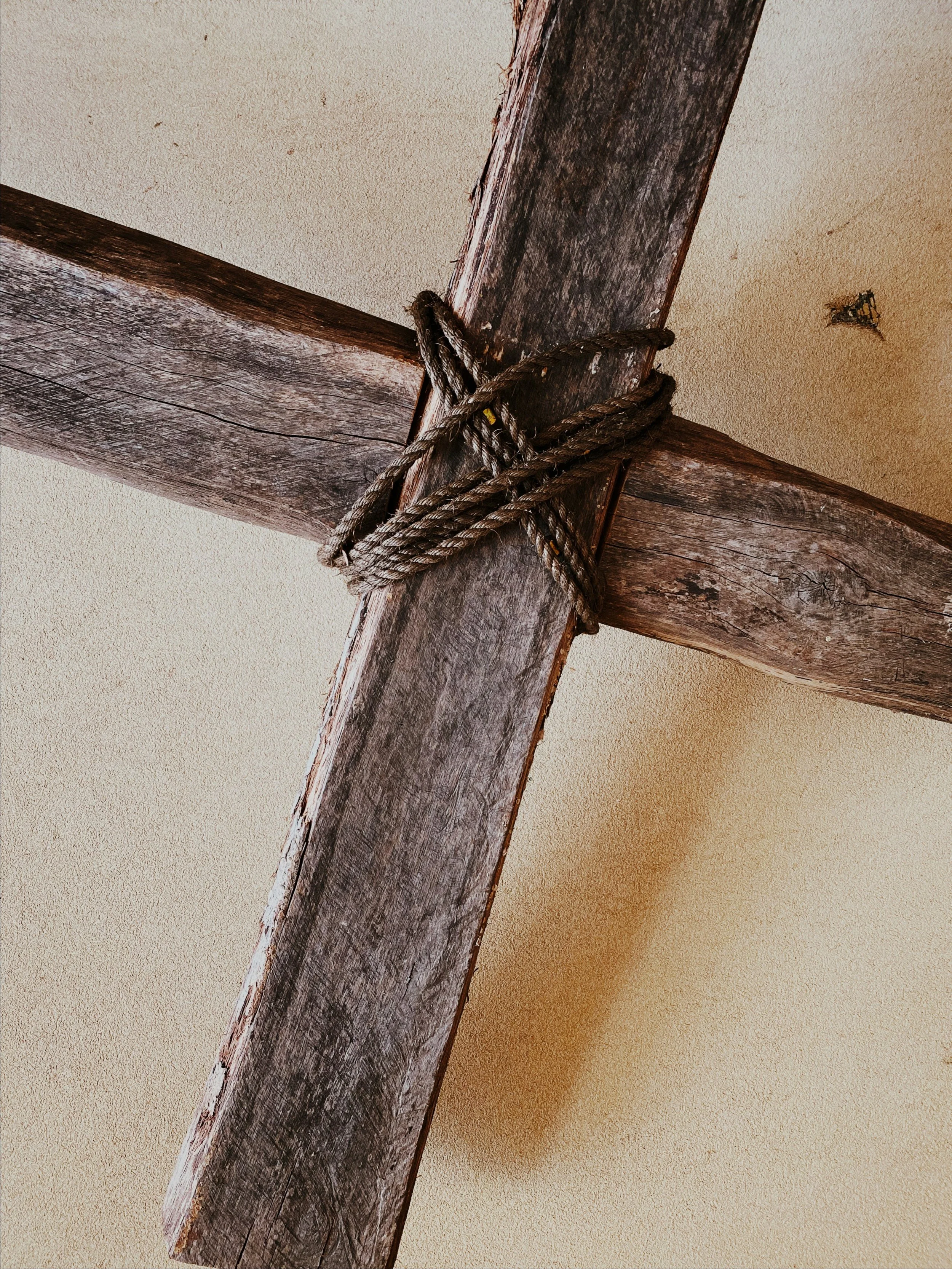
My husband is a woodworker, and a few years ago he fashioned the rough hewn cross that is now featured at the front of the auditorium in our church. The cross is simple, without ornamentation, and might be described as, as the old hymn puts it, “old and rugged.” It is as natural a part of Grace Baptist’s surroundings as the pulpit, chairs, and windows, and is one of various crosses that have hung there since the church’s founding.
How strange.
Visit any Roman Catholic Church, and you’ll find a cross bearing an effigy of Jesus Christ, sorrowful, tortured, agonized, gazing down on parishioners.
Stranger still.
Christians worship in the beauty of a torture device. If Jesus would have come in latter centuries, we might have been worshiping beneath an electric chair, rifle, gas chamber, or hypodermic needle.
Now that would be super strange.
Yet on any given Sunday, folks might be heard singing lyrics such as:
When I survey the wondrous cross on which the Prince of glory died…
or
…and I love that old cross where the dearest and best for a world of lost sinners was slain. So I’ll cherish the old rugged cross till my trophies at last I lay down. I will cling to the old rugged cross, and exchange it some day for a crown.
or
O that old rugged cross so despised by the world has a wondrous attraction for me.
or
In that old rugged cross, stained with blood so divine, a wondrous beauty I see.
or
Hallelujah for the cross!
What’s There to Love?
According to Britannica:
Usually, the condemned man, after being whipped, or “scourged,” dragged the crossbeam of his cross to the place of punishment, where the upright shaft was already fixed in the ground. Stripped of his clothing either then or earlier at his scourging, he was bound fast with outstretched arms to the crossbeam or nailed firmly to it through the wrists. The crossbeam was then raised high against the upright shaft and made fast to it about 9 to 12 feet from the ground. Next, the feet were tightly bound or nailed to the upright shaft. Over the criminal’s head was placed a notice stating his name and his crime. Death ultimately occurred through a combination of constrained blood circulation, organ failure, and asphyxiation as the body strained under its own weight. It could be hastened by shattering the legs with an iron club, which prevented them from supporting the body’s weight and made inhalation more difficult, accelerating both asphyxiation and shock.
Christians venerate this horror as something beautiful.
Why?
In a word: Love.
The History
The beauty of the cross lies in the history of man and the holiness of God.
God had created the universe. He was pleased with his creation, until those he created to bear his image and have dominion over the earth disobeyed him. Sin came into the world and God’s holiness and perfection could not bear it. His wrath bore down on his beloved creatures, resulting in their banishment from his presence and from the paradise in and over which he had placed them (Genesis 1-3). Adam and Eve fell and took every bit of creation down with them. Ever since, mankind has walked in enmity with God (Romans 5:12).
With each subsequent generation, man became increasingly wicked. So God wiped out his creation, save for a few righteous remnants, Noah and company (Genesis 6). Noah’s clan started over, and although some followed God, most, once again, went astray.
God then chose a select group of people and made a covenant with them. This select group were the Hebrews, later known as the Israelites, then the Jews. The sign of the covenant, strangely enough, was circumcision (Genesis 17). Circumcision was an outward sign of an inward commitment, and preceded the giving of the law (the Ten Commandments) to Moses (Exodus 19-20).
From the sign of circumcision until Christ’s resurrection, the Jews were under a covenant of works. In other words, favor with God was achieved first through circumcision, then by a complex system of rules, regulations, and rituals, known as the Law. The Law was established to reveal man’s sin juxtaposed with God’s holiness, and demanded that sacrifices be made regularly in order to atone for the many, many sins (intentional and unintentional) of the people.
In the course of history, God, ever sovereign and ever long suffering, demonstrated his love to the Jews again and again by reaching out to draw them back to himself. He sent prophets to encourage, to rebuke, and to warn them. Though they repeatedly broke his Law, God repeatedly forgave them and brought them back into his favor.
The history of the Israelites is one of cyclical leaving and returning to the God who loved them and chose them for his own.
The Solution
The Law was never intended to bring salvation. It was given specifically to make God’s people conscious of sin, so that they would see their unrighteousness in light of his holiness.
The law was given in preparation for the coming of Christ, because without knowledge and awareness of our sin, we would never see a need for a Savior, thus making Christ’s sacrifice void of meaning.
In his death, Christ became a “righteousness apart from the law” (Romans 3:21), because the Law was fulfilled through and only in him. So those who, by faith, believe in the true purpose of his death and resurrection become righteous and blameless, as if man had never fallen.
In Christ, human beings are restored, so to speak, to their factory settings!
Even the best among us are steeped in sin. Though God’s heart is, to its core, compassionate, his holiness dictates that he exercise his righteous wrath on sinners because he cannot abide sin. The Law, given by God to elucidate that sin, says that an atoning sacrifice must be made to appease God’s wrath and bring us into accord with him once more.
And what does that atonement look like? In a word, bloody. God, in his peculiar sovereignty, requires blood for atonement of sins. Before Christ atonement was achieved through repeated sacrifices of bulls, goats, and lambs.
But Jesus fulfilled the law’s requirement once for all on the cross. He was the final, perfect, and ultimate sacrificed lamb.
The Beauty
God explains, “For the word of the cross is folly to those who are perishing, but to us who are being saved it is the power of God” (1 Corinthians 1:18). The cross is my rescue. It is the bridge between a fallen people and a perfect God. The chasm between sin and holiness is simply too great for anyone to cross.
The beauty of the cross is in the sacrifice of the perfect man who put himself there in my place. Because I, like every human, have “fallen short of the glory of God” (Romans 3:23).
The beauty of the cross is in the love God showed to us in that “while we were still sinners Christ died for us” (Romans 5:8). He didn’t have to do it. He is perfectly happy within the Trinitarian relationship he enjoys with his Father and his Spirit. But he loved us to the point of his own suffering because he is eager for us to share in that perfect, peerless, transcendent, quintessential love. That is the beauty, that “wondrous attraction”, of the cross.
Don’t waste another second thinking the truth is only in what you see. Don’t squander whatever time you have left on earth scoffing at this strange-but-true plan of salvation. Because there is a world that “no eye has seen, nor ear heard, nor the heart of man imagined”, that “God has prepared for those who love him” (1 Corinthians 2:9).
Join with me in singing:
See, from his head, his hands, his feet,
sorrow and love flow mingled down.
Did e'er such love and sorrow meet,
or thorns compose so rich a crown?
Were the whole realm of nature mine,
that were a present far too small.
Love so amazing, so divine,
demands my soul, my life, my all.